Kaisha no Shikumi: Subscriptions — where the fee sits differs by company
Money paid every month or every year can be called a fee in each case and still play a different role. Some companies earn on the fee itself; others place the fee only as a doorway.
The book “Kaisha no Shikumi: Subscriptions” compares where the fee sits, using the accounts of 8 companies. Where does the fee appear in sales, and where does it work on profit? Change the yardstick and the lead role changes with it.
This article is a summary of the main points of each chapter. Click a company name to see its figures.
Costco
Membership fee income equals 51.3% of operating income.
Membership fee income of US$5.3 billion is less than 2% of sales, but equals 51.3% of the US$10.4 billion consolidated operating income. A bit part measured by sales, a lead role measured by profit.
Amazon
The fee is a doorway rather than a source of earnings.
The Prime annual fee is ¥5,900, yet the segment that includes fees is 6.9% of total sales. What is large in the accounts is the commission received from third-party sellers. The same kind of annual fee, sitting in a different place.
Netflix
Raised prices 8 times, and members grew.
The standard plan in the United States went up 8 times between 2014 and 2026. Year-end membership still rose above the previous year in every year that can be confirmed, through FY2024. The cost of producing a title is fixed regardless of member numbers.
Adobe
Stopped selling software.
It switched from selling outright to selling contracts, changing the way income arrives. The company itself warned that total sales for FY2013 would fall. The book follows year by year how the bottom for sales and the bottom for profit came apart.
Oisix ra daichi
No fee, and it arrives every week.
It charges regular members no basic fee. A subscription box whose contents are decided and delivered unless the customer changes them means money arrives regularly even at a fee of zero. Sales for the year ended March 2026 were ¥251.4 billion.
Curves Holdings
Publishes its churn rate, in figures, every year.
It discloses its average monthly withdrawal rate every year. But the ¥85.6 billion of chain-wide sales is the total customers paid, while what appears in the accounts is consolidated sales of ¥37.57 billion. Change the yardstick and the lead role changes.
RIZAP Group (Chocozap)
Kept the price at ¥2,980 a month while adding gyms.
The monthly fee is ¥2,980 before tax, unchanged since launch. Membership and gym count grew faster than at any of the 8 companies covered in the book.
Nintendo
Earns by selling outright, in the age of subscriptions.
About 96.8% of sales sits in the dedicated video game platform segment. For the other 7 companies, recurring payments were either the pillar of sales or the entrance to it. This company alone puts buying at the centre.
Line up the 8 companies and, within the same business of money arriving regularly, where the fee sits differs by company. Companies that earn on the fee, companies that gather customers with it, companies that build recurrence without charging a fee at all, and a company with no recurrence.
Treating everything under the single word fee leads to misreading the accounts. The book opens each company in turn.
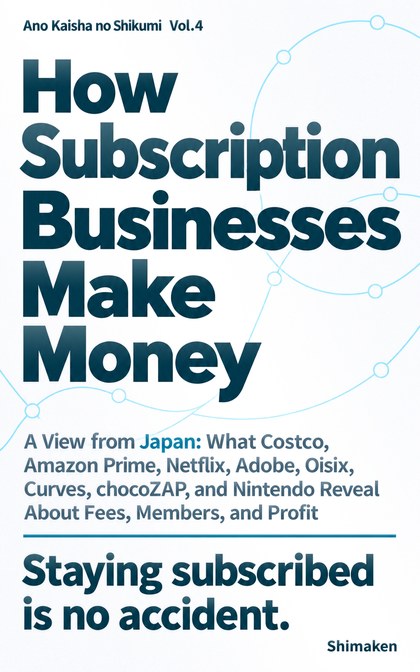 “Kaisha no Shikumi: Subscriptions”
Costco, Amazon Prime, Netflix, Adobe, Oisix, Curves, Chocozap, Nintendo
“Ano Kaisha no Shikumi” series, Vol.4 — Kindle and paperback
Figures are from each company's annual securities report, annual report (Form 10-K) and results materials. Fiscal year ends and accounting standards differ from company to company, and amounts for U.S. companies are in dollars. This article is for information; it is not a recommendation to buy or sell the shares of any company.