Kaisha no Shikumi: Buying to Resell or Brokering the Sale — 6 companies sorted by whether they hold inventory
The accounts of companies that deal in secondhand goods carry different lines from one company to the next. A company that buys shows purchases and inventories; a company that brokers shows the value of goods traded and the number of users.
The book “Kaisha no Shikumi: Buying to Resell or Brokering the Sale” sorts the accounts of 6 companies by that difference. Buy from the customer and sell in your own stores, sell to dealers, or broker the sale without buying at all. Across those 3 types, the lines that appear in the accounts change places.
This article is a summary of the main points of each chapter. Click a company name to see its figures.
Bookoff Group
It buys books in bundles, by category and quantity.
In the year ended May 2026 it bought about 409.36 million items in Japan and sold about 279.99 million. It does not track the cost of each copy of a book, managing them by category and quantity instead. Of sales of ¥130.1 billion, 86.6% is the domestic Bookoff business.
Komehyo Holdings
Purchases from individuals went from ¥34.1 billion to ¥104.1 billion.
The ¥34.1 billion of the year ended March 2022 was ¥104.1 billion in the year ended March 2026. Appraisers examine each item on its own. The same company also runs a dealer auction, where what becomes its sales is the fee, not the value of the goods traded.
Geo Holdings
It turned its rental stores into secondhand stores.
Reuse went from ¥99.4 billion in the year ended March 2018 to ¥300.6 billion in the year ended March 2026, and Rental from ¥66.6 billion to ¥25.1 billion. The category with the highest gross margin is still Rental at 62.7%, while the larger gross profit in yen is Reuse.
Treasure Factory
The sales floor and the buying counter are in the same store.
In the year ended February 2026 purchases of merchandise were ¥20.7 billion and company-operated stores numbered 288. The same store is where ¥48.6 billion of sales is made and where the goods to be sold next year are collected. Inventories at the year-end were ¥9.1 billion.
Valuence Holdings
It buys from the customer and sells to dealers.
Sales by channel in the year ended August 2025 were about 80% to dealers and about 20% retail to individuals. Purchases were ¥66.0 billion. The same company also brokers goods left with it by other firms, at its own auction.
Mercari
It buys no goods, and takes 10% each time a sale closes.
In the year ended June 2026 the value of goods traded on the Marketplace in Japan was ¥1.2856 trillion, and 24.19 million people used it at least once a month. The consolidated statement of financial position has no line for inventories, and no figure showing how inventory turns.
Sorting the 6 companies by whether they hold inventory gives 3 types: buy and sell in your own stores, buy and sell to dealers, and broker without buying. A type belongs to a business rather than to a company, so one company can hold 2 or more of them.
In the secondhand business, profits depend not just on selling prices, but on whether a company buys goods for resale or earns fees by connecting buyers and sellers. The book opens each company in turn.
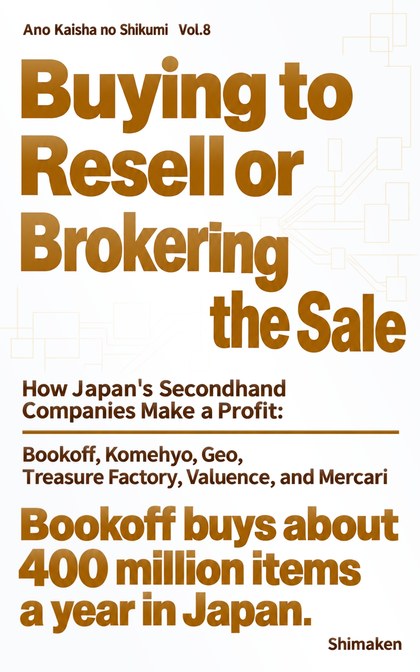 “Kaisha no Shikumi: Buying to Resell or Brokering the Sale”
Bookoff, Komehyo, Geo, Treasure Factory, Valuence, Mercari
“Ano Kaisha no Shikumi” series, Vol.8 — Kindle and paperback
Figures are from each company's annual securities report, earnings release and results presentation. Fiscal years and the scope of each business differ from company to company, so the margins here do not support a judgement that one company is better than another. Mercari reports under IFRS, so its top line is revenue. This article is for information only and is not a recommendation to buy or sell the shares of any company.