Kaisha no Shikumi: Franchising — what head office takes from its franchisees
What you pay at a convenience store first becomes the franchisee's sales. What reaches head office is the share it takes from that.
The book “Kaisha no Shikumi: Franchising” lines up 7 chains on a single question: what does head office take from its franchisees, and how? Take it from the gross margin, take it as a royalty, take it by selling goods. Even within franchising, the way of taking differs by company.
This article is a summary of the main points of each chapter. Click a company name to see its figures.
Seven & i Holdings
Of 20,000 shops in Japan, only 158 are its own.
Of the 21,722 Seven-Eleven shops in Japan, 158 are company-operated (as of the end of February 2026). What head office receives is a royalty taken from the franchisee's gross margin, at a rate between 43% and 76%.
Zensho Holdings (Sukiya)
Books the sale itself, with no franchisee in between.
What you pay for a beef bowl at Sukiya becomes consolidated sales without passing through a franchisee. Leaving shops to other people and taking a cut of the gross margin, or holding them and receiving the sales directly: within the same word, chain, the path the money takes is reversed.
Workman
Head office takes a high share, and the franchisee still keeps a profit.
Head office receives 60% of the franchisee's gross margin, so the rate itself is not low. Even so, the average franchisee income the company publishes is about ¥12 million, and the contract renewal rate is over 96%.
Ichibanya (CoCo Ichibanya)
Does not recruit franchisees from the public.
118 company-operated shops against 1,087 franchised ones. It does not advertise for franchisees; people who worked as its own employees go independent and become owners. The royalty in Japan is zero, and about 60% of head office sales is payment for ingredients sold to franchisees.
Mos Food Services
Earns by selling ingredients, not by charging for the name.
53% of head office sales is payment for ingredients and packaging sold to franchisees. What franchisees pay for the use of the name stays at 1% of monthly sales. The more a franchisee sells, the more it buys.
Duskin
Holds 2 franchises of quite different character.
A home-visit service for cleaning products, and Mister Donut. For the year ended March 2026 the food group had sales of ¥68.9 billion and profit of ¥10.0 billion, a 14.5% margin, while the company-wide operating margin is 4.5%.
Toridoll Holdings (Marugame Seimen)
Deliberately does not franchise.
All 887 shops in Japan (as of the end of March 2026) are company-operated, and there is not a single franchise. The company explains that operating its own shops, rather than franchising, is the best fit.
Line up the 7 companies and head office's share falls into 4 broad shapes: take it from the gross margin, take a rate on sales, take it by selling goods, or take nothing and run the shops yourself.
There was no general rule that franchising produces profit. There is only the design of where the money is taken from. The book opens each company in turn.
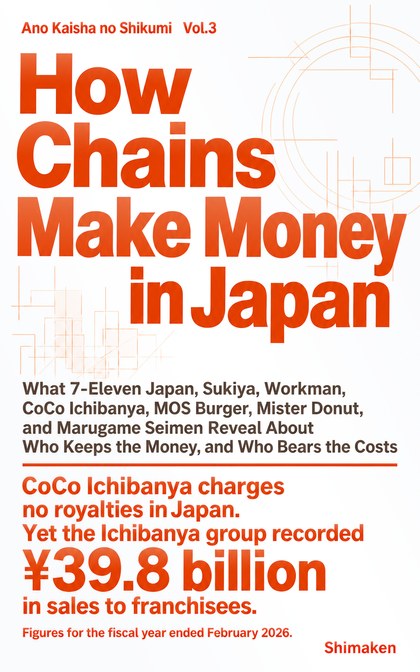 “Kaisha no Shikumi: Franchising”
Seven-Eleven, Sukiya, Workman, CoCo Ichibanya, Mos Burger, Mister Donut, Marugame Seimen
“Ano Kaisha no Shikumi” series, Vol.3 — Kindle and paperback
Figures are from each company's annual securities report, results materials and franchise recruitment materials. Fiscal year ends differ from company to company. This article is for information; it is not a recommendation to buy or sell the shares of any company.