Kaisha no Shikumi: Dividends — what lining up 8 companies showed
Most of what you pay for a coffee at Komeda never appears in Komeda Holdings' sales. Of 1,030 shops in Japan, only 22 are run by head office; the rest belong to franchise owners (as of the end of February 2026).
The book “Kaisha no Shikumi: Dividends” lines up that kind of design of money flows across 8 companies. The conclusion fits in one sentence: dividends come from structure, not from results. What separated the 6 companies that kept raising the dividend from the 1 whose dividend had not moved in 6 years was not how hard people worked, but who carries the costs.
This article is a summary of the main points of each chapter. Click a company name to see its figures.
Komeda Holdings
Not a company that sells coffee, but one that wholesales ingredients to coffee shops.
68.7% of ¥57.2 billion in revenue is wholesale of ingredients and supplies to franchisees (calculated). The royalty is a flat ¥1,500 per seat per month, so the fruits of a busy shop stay with the owner. Rent and labour are shared by the owner, while head office holds the factories and the logistics. Operating margin 16.5% (year ended February 2026).
Doutor Nichires Holdings
The same coffee, earned in a different way.
Doutor Nichires, which runs mainly its own shops, has an operating margin of 6.4%. The gap against Komeda's 16.5% comes not from the taste of the coffee or the number of shops, but from how the money is designed to flow (both for the year ended February 2026).
Nitori Holdings
Makes it, moves it and sells it, all itself.
Shop sales are 85.1% of consolidated revenue (year ended March 2026). Unlike Komeda, it carries every heavy part of the work itself. The answer to how a high margin still comes out lies outside the shops, in the manufacturing and logistics it owns.
Pan Pacific International Holdings (Don Quijote)
Retail that lets the shop floor decide.
How goods are stacked is decided on the floor, not at head office. Net sales ¥2,445.2 billion and operating income ¥174.8 billion (year ended June 2026), with the dividend raised for 23 years running. Shop floors that look chaotic produce a disciplined dividend.
McDonald's Holdings Japan
A hamburger chain and a landlord.
76.7% of 3,025 shops are franchised (calculated). Profit from products, and profit from the land and buildings under the shops. It earns on 2 streams of different character, one stacked on the other.
MonotaRO
Selling a single screw through data.
28.66 million items listed (as of the end of the interim period to December 2026). On a factory floor a stock-out is a question of time, not price. Data supports a range that arrives the next day, replacing the way indirect materials are bought.
Kobe Bussan (Gyomu Super)
A food factory wearing the face of a supermarket.
Only 4 of 1,122 shops are company-operated (calculated). The reason things are cheap lies outside the shop, in the food factories and the import operation it owns.
Yamato Holdings
A structure where working harder cannot raise the dividend.
Placed here as the contrast. Unlike the companies above, it holds the work of delivering itself. The reason the dividend does not move lies in the shape of the costs, not in how people work. A difference of structure shows up directly in how the dividend moves.
Line up the 8 companies and a common thread appears. Whether a company let go of the front line or took it in house, it always holds something upstream. Komeda gave up the shops and holds the factories; Nitori carries everything and owns the manufacturing and the logistics too. The directions are opposite, but what they hold is where the profit and the dividend come from.
The results figures for each company are all on the pages linked above. The full analysis, connecting the 8 companies, is in the book.
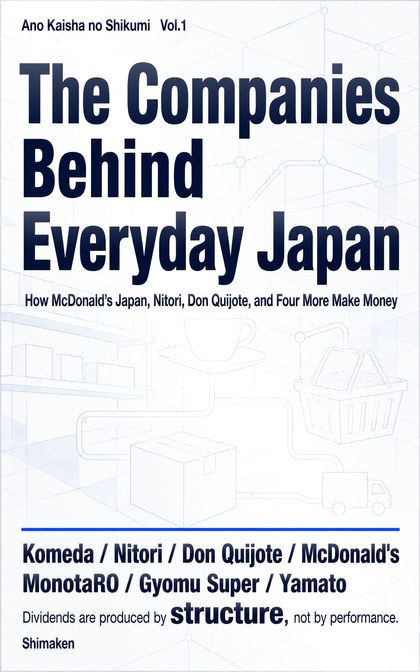 “Kaisha no Shikumi: Dividends”
Komeda, Doutor, Nitori, Don Quijote, McDonald's, MonotaRO, Gyomu Super, Yamato
“Ano Kaisha no Shikumi” series, Vol.1 — Kindle and paperback
Figures are from each company's annual securities report and results materials. Fiscal year ends differ from company to company. This article is for information; it is not a recommendation to buy or sell the shares of any company.