Kaisha no Shikumi: Raising Prices — what lining up 6 companies showed
Prices rose in the same period and in the same way, and yet what companies did about it split widely. Some raised prices, some did not, and some tried and could not make it work.
The book “Kaisha no Shikumi: Raising Prices” reads that difference out of the accounts of 6 companies. To give the conclusion first: there was no single correct way to price. There was only a difference in design, in what else a company can move besides the price.
This article is a summary of the main points of each chapter. Click a company name to see its figures.
Saizeriya
Built a shape where it never has to raise prices.
For the year ended August 2025, net sales ¥256.7 billion and operating income ¥15.5 billion. Operating income was 6.0% of net sales. What a customer pays in the restaurant becomes the company's sales directly, and instead of moving prices it keeps the things it can move somewhere else.
FOOD & LIFE COMPANIES (Sushiro)
The same restaurant business, moving prices in the opposite way.
It separates price bands by the colour of the plate, keeping the room to move prices themselves inside the restaurant. That is the opposite stance to Saizeriya, which holds prices still and adjusts elsewhere.
Fast Retailing (Uniqlo)
Failed at raising prices once, and learned to make it work.
In November 2015, same-store sales in Japan fell 8.9% year on year and customer numbers 12.9%. From there it strengthened a shape carrying research, planning, material sourcing and selling in house, and for the year ended August 2025 posted revenue of ¥3,400.5 billion and operating income of ¥564.3 billion (a 16.6% margin).
Ryohin Keikaku (Muji)
After the stumble, rebuilt the structure of its prices.
In April 2023, sales at existing stores and online in Japan fell to 85.8% of the same month a year earlier. It separated what to raise from what to hold, put different products into the cheapest band, and rebuilt the structure of its prices.
Shimamura
Stopped discounting before raising prices.
For the year ended February 2026, net sales ¥700.0 billion and operating income ¥61.5 billion (an 8.8% margin), a record for the fifth year running. It owns no factories; head office buyers source from about 600 suppliers. This company's design shows in the order it chose to lift its margin while the gross margin stayed thin.
Seria
Took not being able to move from ¥110 as the starting point.
For the year ended March 2026, net sales ¥255.7 billion and operating income ¥21.0 billion (an 8.2% margin). Having decided not to move the price, it moves specifications, pack quantities, range, sourcing, stock turnover and the efficiency of store operations instead.
Line up the 6 companies and it becomes clear that being able to raise prices is not a question of nerve. It is how much a company can move besides the price, and when it moved it. What shows up in the accounts is that order.
The figures for each company are on the pages linked above. The full analysis, connecting the 6 companies, is in the book.
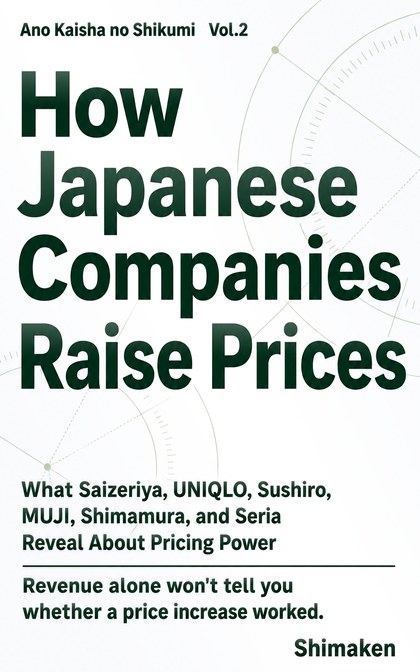 “Kaisha no Shikumi: Raising Prices”
Saizeriya, Uniqlo, Sushiro, Muji and others
“Ano Kaisha no Shikumi” series, Vol.2 — Kindle and paperback
Figures are from each company's annual securities report and results materials. Fiscal year ends differ from company to company. This article is for information; it is not a recommendation to buy or sell the shares of any company.